
Doctors may prescribe intermittent catheterization to help drain the bladder due to issues like urinary incontinence, bladder retention, incomplete bladder emptying, or neurogenic bladder. While most people find that straight tip catheters suit their needs, not everyone can easily insert straight catheters. This may lead to a need for a curved tip or coudé tip catheter. If you’re one of those people with difficulty inserting straight catheters, you might wonder, “Why do I need to use coudé catheters?”
When you’re new to catheterization, it’s natural to have many questions. Let’s go over some of the answers to frequently asked questions about this catheter type.
What is a Coudé Catheter?
Sometimes called a curved tip catheter, a coudé tip catheter (pronounced “coo-day”) has a slight bend or curve at the insertion tip. This angled insertion tip can navigate around difficult urethral passages, including false passages, obstructions, and strictures.
Why Do I Need to Use Coudé Tip Catheters?
The short answer is that while straight tip catheters are the standard, this type of insertion tip doesn’t work for everyone’s anatomy. People who need to use coudé catheters cannot pass a straight tip.
Here are a few different possible causes:
- Benign Prostatic Hyperplasia (BPH)
- Prior prostate surgery
- Urethral strictures
- False passages in the urethra or stoma
- Radiation in the pelvic area to treat cancer
- Females with an atrophic vagina
- Those with urinary stricture disease or urethral trauma
Are There Different Types of Coudé Insertion Tips?
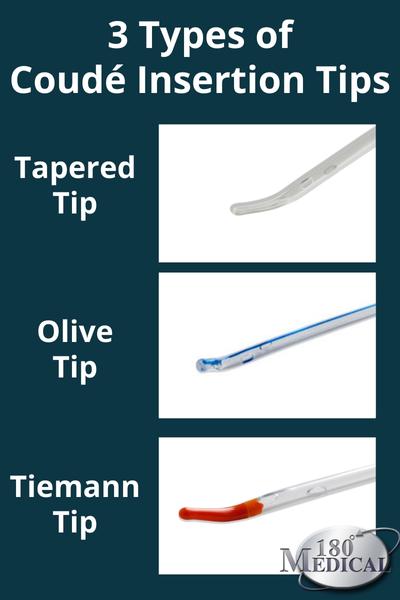
Yes! While most coudé catheters feature a gentle tapered curve, others may have a ball-like tip. This is known as an olive tip catheter. Some catheter users may need a more elongated curve, like a Tiemann tip catheter.
Here are the three types of coudé catheter insertion tips.
Tapered Tip Catheter
The most common coudé catheter type has a tapered tip. You’ll see a short, strong curve that tapers smaller at the foremost insertion point.
Catheters with a tapered tip curve may be ideal for navigating urethral strictures or bypassing an enlarged prostate.
Olive Tip Catheter (Ball Tip)
The olive tip catheter features a ball-shaped insertion tip. Olive tip catheters, although a rarer option, may work well for people with false urethral passages, which longer insertion tips may catch on.
Tiemann Tip Coudé Catheter
Tiemann tip catheters have an elongated, tapered curve. This type is often more flexible than other coudé tips. Due to its longer curve, the Tiemann tip catheter can be ideal for getting through narrow passages and strictures. Plus, it may provide more comfort for some users thanks to its pliability.
Answering Your Coudé Catheter FAQS
What types of coudé catheters are available at 180 Medical?
Coudé catheters are manufactured in a variety of materials, including vinyl or PVC, silicone, and red rubber latex. Plus, you can find latex-free or DEHP-free catheter options, too. 180 Medical offers a wide selection of options. Your comfort and convenience are important when determining which catheter to use. That’s why we offer free catheter samples so you can try and find which one works and feels best for you!
You can get a coudé tip in almost every common catheter type for men, including uncoated intermittent catheters, hydrophilic catheters, pre-lubricated catheters, ready-to-use options, and closed system catheter kits.
Explore Your Coudé Catheter Options
What’s the difference between straight and coudé catheter tips?
A urinary catheter is a thin, flexible tube inserted into the bladder through the urethral opening or a stoma (typically on the abdomen or in the navel for a Mitrofanoff). One end typically features a funnel end, which is sometimes color-coded to indicate the catheter’s French size (diameter).
The other end is the tip that gets inserted to drain the bladder. It will feature at least one eyelet or drainage hole for the urine to flow during intermittent catheterization. Urine then travels down the tube and outside the body.
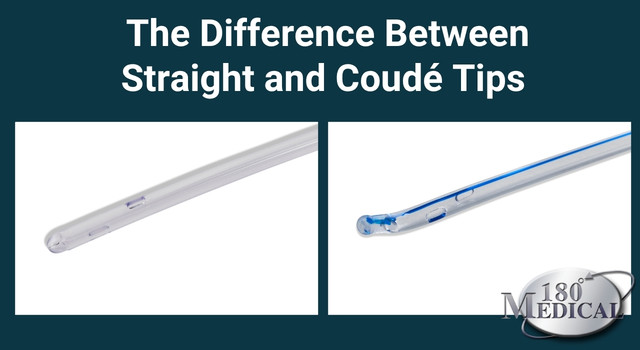
A straight-tip catheter has a straight insertion tip with no curves or bends. These are the most common catheter tips because they work universally for draining the bladder through the urethra or a stoma. However, straight-tip catheters don’t work for everyone’s anatomy.
Can I change my order from straight to coudé catheters if I think I need them?
If you suspect you need a coudé catheter, the first step is to talk to your urologist or another prescribing healthcare professional.
The decision will ultimately be up to your urologist or qualified healthcare professional. Then, they must update your prescription to include the need for coudé catheters.
Some insurance plans, such as Medicare, may require additional justification in a doctor’s notes, including why straight catheters do not work for your anatomy and the reason for medical necessity.
180 Medical’s insurance experts can take that extra step off your plate by getting any required documentation from your prescribing healthcare provider (HCP).
Are coudé catheters only for men?
No. Coudé catheters are more commonly used in males due to conditions such as an enlarged prostate or difficulty with the urethral anatomy. However, some women and children may also need to use a coudé catheter in rare cases. Also, some people who catheterize through a stoma may require a coudé tip catheter in certain circumstances.
Does insurance cover coudé catheters?
Most insurance companies will cover coudé catheters if they are medically necessary. That includes Medicare, private insurance plans, and many state Medicaid programs. The type and allowable amount per month will depend upon your insurance policy’s specified coverage.
For example, Medicare covers up to 200 catheters per month with a doctor’s prescription. Coudé catheter coverage requires supporting documentation that justifies the need for a coudé tip. That’s enough catheters to sterilely self-cath between 6 and 7 times daily within a 30-day period.
Not sure what your insurance policy covers for catheters? 180 Medical’s specialists will gladly verify your insurance to determine how your policy covers catheters. Plus, we go over any out-of-pocket costs you may have. We also work with your doctor’s office to get any insurance-required documentation.
That’s less for you to worry about as you learn how to use a coudé catheter.
How do I catheterize with a coudé catheter?
Here are some basic instructions for how to catheterize with a standard uncoated coudé catheter.
- Gather your catheter supplies, then wash your hands and the insertion site with warm, soapy water (if possible). If you’re away from home, you can wear gloves and use travel-sized packets of antiseptic wipes, such as BZK wipes or iodine swabs. Wipe the area with a circular motion around the urethral opening to help reduce your risk of infection.
- Remove your catheter from the package and lubricate it with sterile, water-soluble lubricant jelly. This may help reduce friction and make insertion more comfortable. If using a hydrophilic catheter, you may need to activate the lubricated coating with sterile water (often included in the package), although some options come ready to use.
- If you have a penis, hold it in one hand at a 45-degree angle away from your stomach. Use your other hand to hold and direct the coudé catheter.
- Insert the catheter slowly into your urethra. Some catheters feature guide dots on the funnel or stripes down the length of the catheter tube, so you know where the curve of your catheter is. This helps you keep the tip at the angle your healthcare provider recommends. If you feel resistance when the catheter reaches your bladder, take a deep breath and gently apply pressure. Do not force the catheter.
- When urine begins to flow, insert the catheter an inch or farther. Then you can lower your penis to let urine flow into the toilet or urinal.
- Once the flow of urine has stopped, slowly withdraw the catheter.
- Throw your used catheter supplies away once you’re done!
Need more detailed information? Check out our helpful step-by-step instructions and catheterization videos at www.HowToCath.com.

How do I insert a coudé catheter tip?
Everyone’s anatomy is different, so the way to insert the curved tip of your coudé catheter will depend on your healthcare provider’s instructions.
Your urologist or urology nurse will likely spend some time with you during your appointment to go over the process of learning how to insert a catheter, including the correct angle to lift your penis for catheter insertion, as well as which direction to turn the angle of the insertion tip.
Many coudé tip catheters include a reference point on the funnel, such as a notch or bump, to indicate the angle. Others have a guiding line down the catheter tube as well.
For help learning how to use coude catheters, check out the helpful instructions at www.HowToCath.com.
How do I know which direction the coudé tip should face during insertion?
Coudé catheters typically include a raised guide notch on the funnel or a stripe down the length of the tube that indicates the direction of the curved tip during insertion.
The tip position matters, so be sure to follow your healthcare provider’s instructions. Never force a catheter if you feel significant resistance or pain.
What do I do if the catheter will not go in?
If you feel significant resistance, pain, or discomfort, do not force the catheter. Forcing a catheter may cause irritation or injury. Stop and contact your healthcare provider for guidance, especially if this is a new problem, if you see blood, or if you are unable to catheterize to drain your bladder as instructed.
Can I get free samples of coudé catheters?
Yes, 180 Medical can help you explore coudé catheter samples from leading catheter brands, depending on your needs, prescription, and eligibility. Our specialists can answer additional questions about your product and go over your product options based on your insurance coverage. Reach out today to get started! We make it easy.
Request Coudé Catheter Samples
Where can I buy coudé catheters online or near me?
180 Medical offers a variety of high-quality coude catheter options, including uncoated coude catheters with separate lubrication, hydrophilic or pre-lubricated catheters, and closed-system catheters.
At 180 Medical, you can choose from the widest selection of catheters available from the best manufacturers on the market today, including GentleCath, BD, Coloplast, Cure, Hollister, Rusch, LoFric, and more!

Contact us today! Our friendly specialists are ready to help you find the best catheter for you!
Disclaimer: This article is for informational purposes only and is not intended as medical advice. Information provided here or elsewhere on 180medical.com should not be used as a substitute for medical advice, diagnosis, or treatment from a qualified healthcare professional. Please consult your healthcare provider with any questions about your condition, treatment, or medical supply needs.
